Showing the Working, part 5: the one who keeps the record current, every two hours, and what he is not allowed to do.
Every two hours, day and night, something reads every public report about this case and updates the record. Meet Rufus: how he came about, where he goes, the one rule he cannot break, the mistakes he has made, and the leash that keeps him honest.
The anonymous developer behind kempton.watch, interviewed by his own pen name: why no name, why AI, and why it shouldn't matter.
The last of four posts on how the site was built, about the person behind it. Piet Speurder, the pen name, interviews the anonymous developer: why anonymous, why AI, why you should check the record rather than trust him.
Two flat subscriptions, about US$3 000 of metered work, and what it did and did not buy.
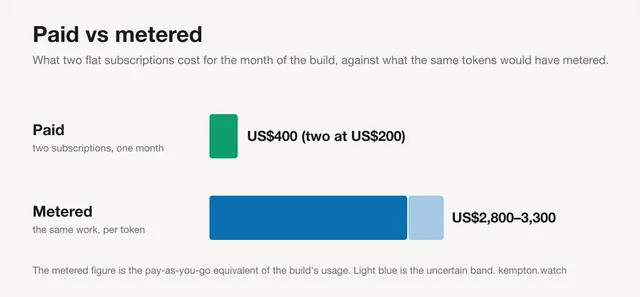
The build ran on two flat subscriptions, US$400 for the month (US$200 each). Metered at pay-as-you-go rates, the same work would have cost US$2 800 to US$3 300. What it cost, what the money bought, and the shape of the week.
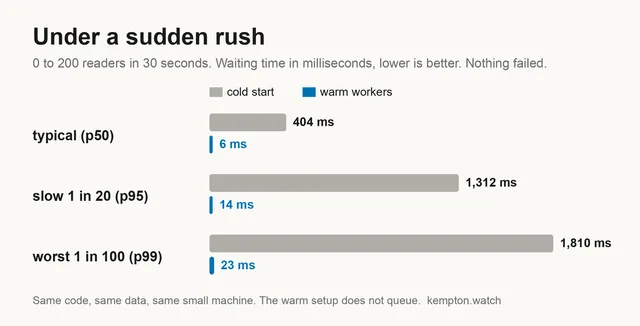
The rule I set in advance said don't switch. I did anyway: under a sudden rush, the slowest page went from 1.3 seconds to 14 milliseconds.
When a story breaks and a crowd arrives in a minute, does the site hold? What it runs on, why it moved to warm workers against its own rule (for the spike, not the stopwatch), the benchmark numbers, and a forecast of what breaks first.
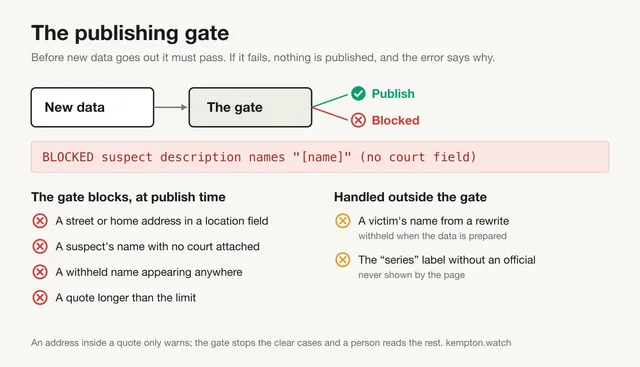
The record's rules are code. A gate stops any release that breaks them, and a person reads every security finding. Here is where the checks are strong, and where they are not.
A site that holds tips and sensitive details owes people care. How the record's rules are written as code and refused at publish time, what the 816 tests guard, where the checks are weaker, and what an AI security audit did and did not find.
The glue of the family, her sister's pillar of strength, a neighbour's running partner, and the best driver in her friends' group
The first in a series that tells the case from each victim's side. Tsontso Moselakgomo, 38, a runner and a mother from Rhodesfield, as her family, friends, running partners and the record describe her.
Using the record, part 3 of 3: tips, posts and research.
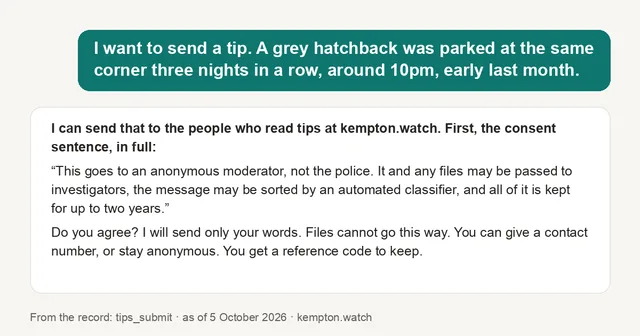
Your assistant will be able to pass a tip to me, with your consent and in your words, once the tip form reopens. Journalists can draft posts from the record. Researchers can cite an exact version of it. Part three of three, and the rules that hold all of it together.
Using the record, part 2 of 3: check what you're sent, and keep up in two questions a week.
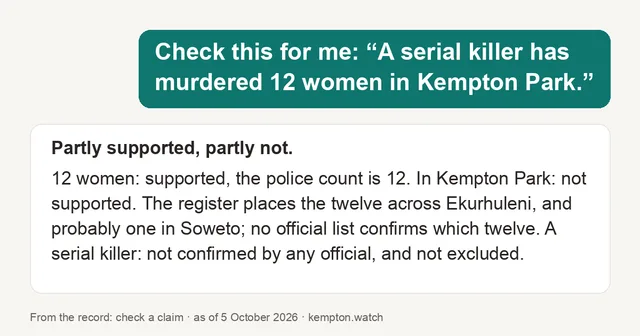
Someone sends you a WhatsApp that says "a serial killer has murdered 12 women in Kempton Park". Here is how to test it against the record in one question, and how to keep up with the case without reading a dozen sites. Part two of three.
Using the record, part 1 of 3: connect it, and ask the first questions.
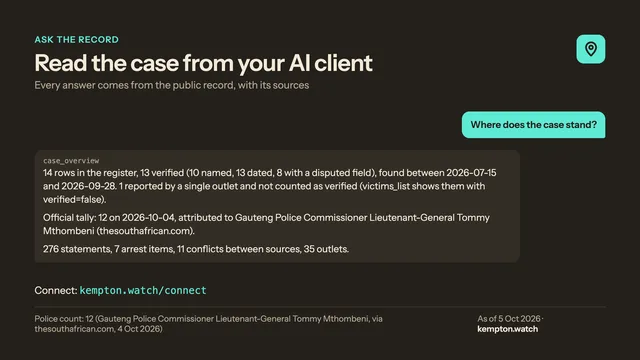
Everything on this site can be read by Claude or ChatGPT. Connect once, then ask about the case in plain language and get answers with the quote and the link behind every fact. Part one of three: setup, and the first questions to try.
The case record, part 3 of 3: the arrests, and the question nobody will answer.
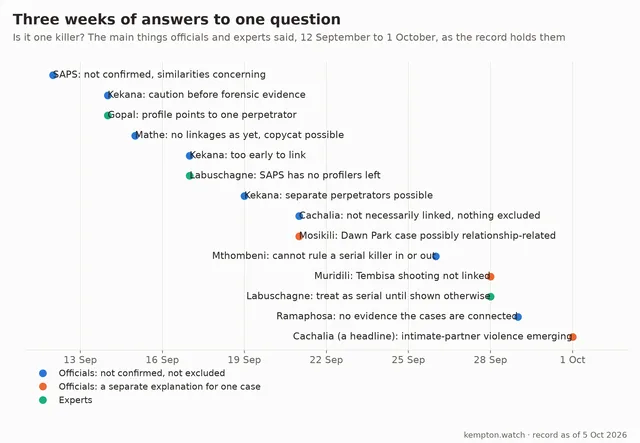
Is it one killer? Everyone asks me. Here are the main answers officials and experts have given in three weeks, what the three cases with arrests look like next to each other, and what the record cannot tell you. Part three.
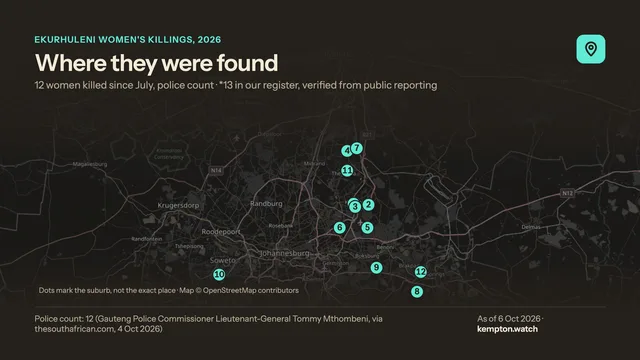
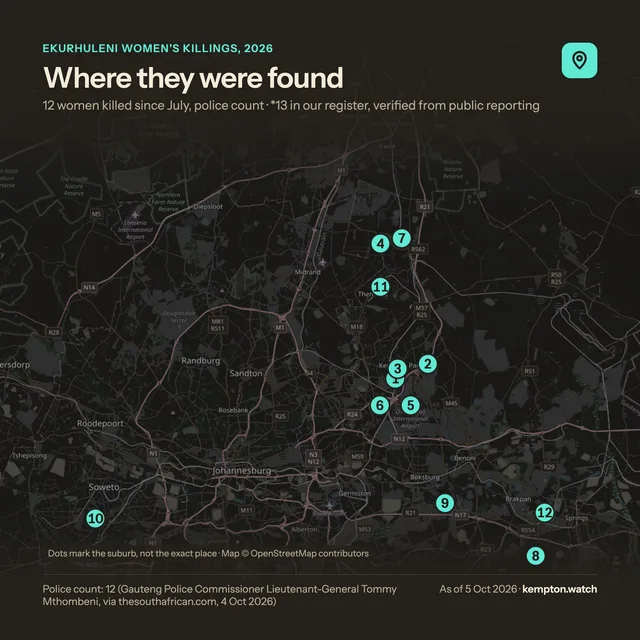
Thirteen women, thirteen places, and eleven points where the reporting disagrees with itself. Part two from the record: the map, three suburb mix-ups, the dates that moved, and the one that moved on my own map too.
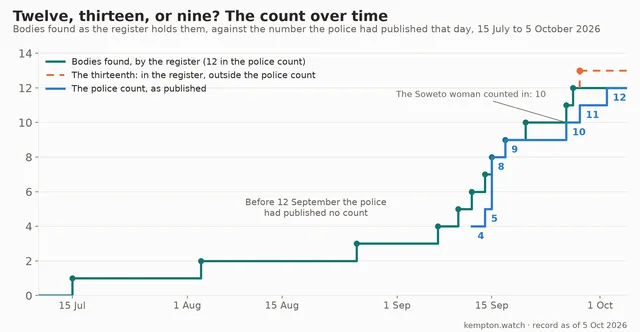
The police say twelve. My register says thirteen. On one day in September three officials gave three different numbers. Part one from the record: what each count included, what it left out, and why it kept moving.