About Me
The anonymous developer behind kempton.watch, interviewed by his own pen name: why no name, why AI, and why it shouldn't matter.
By Piet Speurder · · updated · 6 min read
About aboutanonymityhow it's builtinterviewseries
The last of four posts on how the site was built, about the person behind it. Piet Speurder, the pen name, interviews the anonymous developer: why anonymous, why AI, why you should check the record rather than trust him.
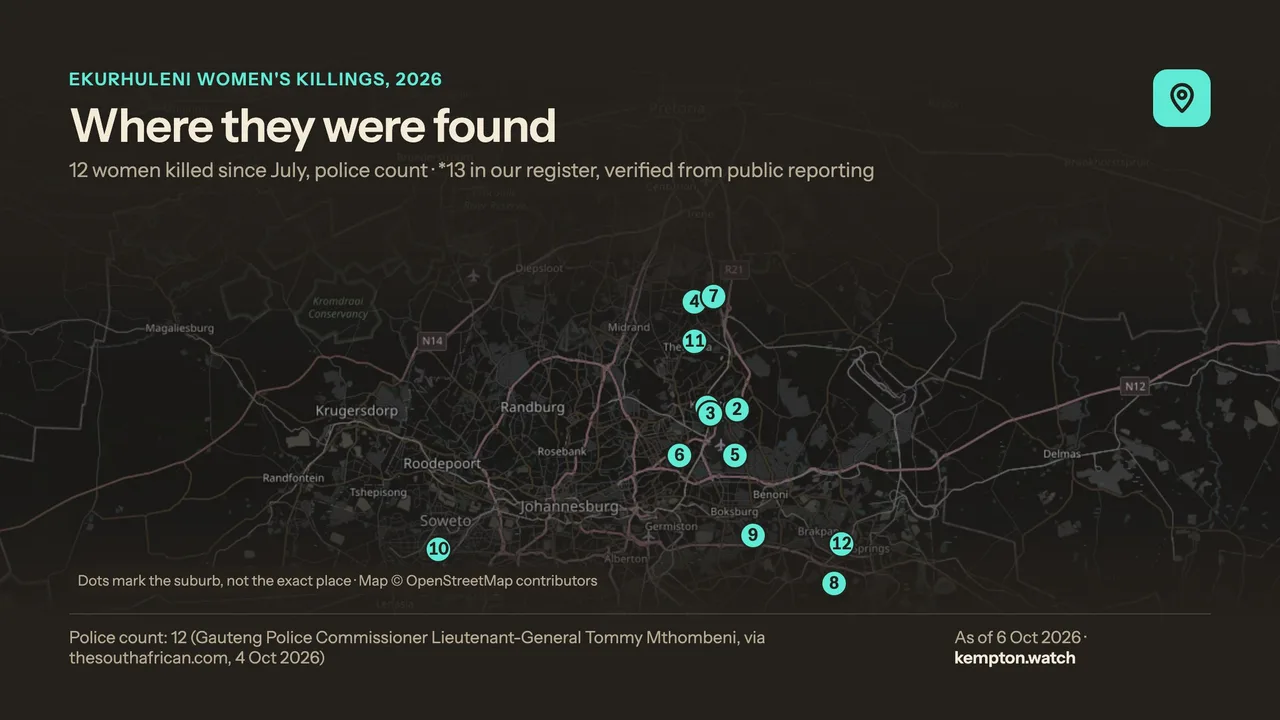
Source: kempton.watch
This is the last of four posts about how kempton.watch was built. The first three were about the work: what the site refuses to publish, how it holds up when a crowd arrives, and what it cost. This one is about the person, which is harder, because the person would rather you looked at the record.
Who is behind this
A developer. Someone who has built web applications for years and knows how to make software that other people can check. Grew up in Kempton Park. Lives abroad now. Not a police officer, not a detective, not a journalist, and not related to anyone in the case.
That is nearly the whole portrait, and it is meant to be. What matters about the person is small and can be said plainly: he has the skill to build a sourced record, the time to keep it current, and a reason to care about a town he comes from. The name is a nod to the late detective Piet Byleveld, who worked cases like these with patience and a notebook. It is a tip of the hat, nothing more. Piet Speurder has no badge and makes no claim to one.
The rest, the real name and everything that would lead to it, stays off the page on purpose. Here is that conversation.
The interview
Piet: Let us get it over with. Who are you, and why won't you say?
The developer: I am not going to say, and I want to explain why rather than just refuse. In September a man was killed by a mob in Kempton Park, reportedly over these murders (TimesLIVE); the police say the motive is not confirmed. That is the world this record lives in: people are frightened and angry and sometimes wrong about who did what. A name attached to this site would put that heat on a household instead of on the record. Criticism is welcome, and the sources page says where to send it. But the site is built so that you do not need my name. Every fact links to its source. You can check the whole thing without trusting the person who assembled it. That was the design, not an afterthought.
Piet: Why build this at all? Why not leave it to the news?
The developer: Because the news, doing its job, left a gap. A dozen outlets covered this, and they disagreed on dates, on suburbs, on how many women. Nobody was keeping the one thing that was missing: a single place where every version sits next to its source and the disagreements are shown instead of smoothed over. I could build that. So the question became why not.
Piet: You built it with AI. The hard version of the question: are you using murdered women to show off a tech toy?
The developer: I have thought about that one a lot, because it is not an unfair question. The women come first, in importance, and the record is the point. The AI is how one person with no budget did in a week what used to need a newsroom. It bought reach, not authority; it did not make a single fact true. If the tool had never existed, I would still have wanted this record to exist. The tool only made it reachable for someone like me.
Piet: Then why should anyone trust a record kept by a man who will not give his name?
The developer: They should not, and I mean that. Do not trust it. Check it. That is the whole idea. A record you have to take on faith is worth nothing, whoever signs it. This one shows its working on every line. The links go to the outlets and the official statements, not to me. If I vanished tomorrow, the sources would still be there and still say what they say.
Piet: What stops you putting your own spin on it?
The developer: The structure, mostly, not my good character. Where outlets disagree, the site shows every version and settles nothing. A claim without a quote in the archived article gets dropped. The count needs an official source or two independent outlets, so I cannot nudge it alone. I built the rules so that my opinion has nowhere to enter, because my opinion is not evidence.
Piet: How do you decide what not to publish?
The developer: That is most of the work. Victims are named only as officials or on-the-ground outlets named them: never from a rewrite, never from me. Suspects are described, never named, unless a court has named them. Locations are discovery sites at suburb level: no homes, no last-seen addresses. The question I ask on anything new is not "is it true" but "could this hurt someone, and does the reader need it". Usually the answer removes more than it keeps.
Piet: The tip form is paused. Why take tips off a case site?
The developer: Because I am an anonymous volunteer with no line to the police, and a tip form on that basis is a promise I cannot keep. Someone could send something urgent, and I am not equipped to act on it responsibly alone. So the form stays closed until an organisation that knows this work helps vet what comes in. Until then the site points to Crime Stop on 08600 10111, which is anonymous and staffed, and to 10111 if someone is in danger now. A paused form is better than a false promise.
Piet: What do you say to the families?
The developer: Very little, and carefully, because it is not my grief to narrate. Only this: the record tries to keep her a person and not a statistic, to get her name right or not use it at all, and never to let a guess stand where a fact should be. If I got anything wrong, the sources page says how to tell me; I fix it as fast as I can, and the changelog says when. One day I would rather hand the whole thing to an organisation that could keep it better, with names and a real line to the services, than have it stay a one-person project. It is not mine in any way that matters.
After
That is the maker, as much of him as the work allows. The point was never the person. It was so you know who stands behind the record, and why you can check every line of it without taking his word for anything. He built it so that he would not have to be believed.
Everything on the site shows its working: kempton.watch/sources
— Piet
Showing the Working — how this site was built: What This Site Refuses to Publish · Built for the Worst Day · The Bill, Itemised · Don't Trust Me. Check the Record.