Twelve, Thirteen, or Nine? The Actual Count
The case record, part 1 of 3: the number.
By Piet Speurder · · updated · 8 min read
The case IMC listpolice countsourcesthe count
The police say twelve. My register says thirteen. On one day in September three officials gave three different numbers. Part one from the record: what each count included, what it left out, and why it kept moving.
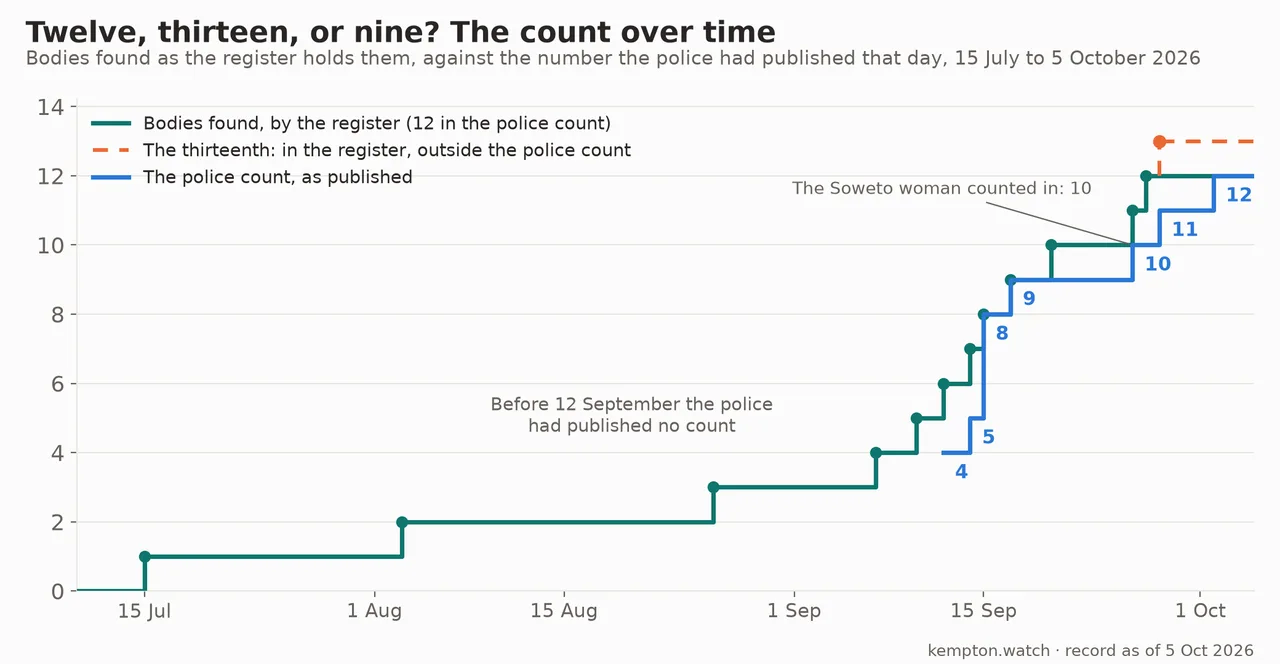
Chart: Kempton Watch, from the record as of 5 October 2026
On 2 October the Gauteng police commissioner, Lieutenant-General Tommy Mthombeni, said twelve. Twelve women found dead in the cases Gauteng police are investigating. My register says thirteen. Both numbers are right. Neither tells you much until you know what was counted.
This is the first of three pieces I'm writing from the record on this site. This one is about the number. The next one is about the places, and where the reporting put them. The third is about the arrests, and the question everyone asks me and no official has answered.
Four
The first number was four. On Saturday 12 September the police warned women in Kempton Park: four bodies in about two months, in and around Rhodesfield, with similarities "sufficiently concerning" to say so out loud, even though the police "had not, at this stage, confirmed that the deaths are linked to a serial killer". The statement is on gov.za, dated two days later.
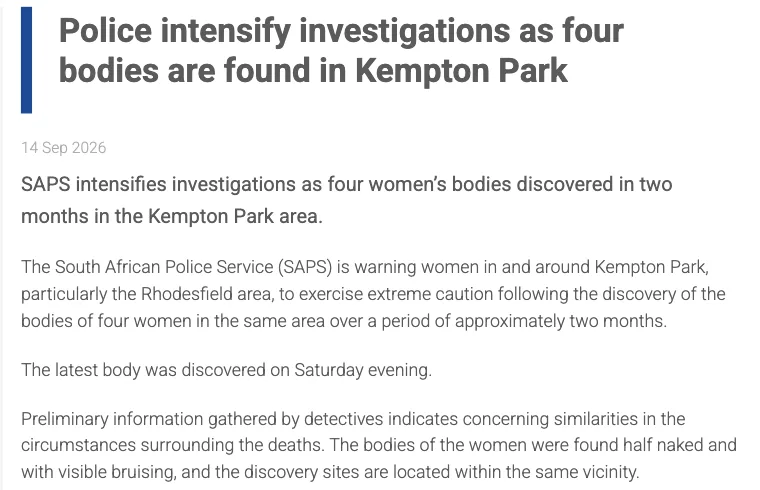
Which four? The statement doesn't say, and the record can't tell you either. By 12 September my register has six women found in and around Kempton Park and Tembisa: Busisiwe Mahlangu on 15 July, Itumeleng Kekana on 3 August, Nomfesane Mjobo on 26 August, an unidentified woman in the Clayville river on 7 September, Gracious Nkomo on 10 September, and Elizabeth Moselakgomo on the evening of the 12th itself. Four of those six were the police's four. I don't know which, so I don't guess.
Five, seven, eight, in one day
Tuesday 15 September is the day the count came apart.
A woman the news called the sixth was found in KwaThema that morning: Dineo Motapane, the eighth in my register. Vutomi Mathebula had been found in Olifantsfontein the day before. The national police spokesperson, Brigadier Athlenda Mathe, spoke of five women in Kempton Park besides the KwaThema woman. The same day the acting Gauteng commissioner, Major-General Fred Kekana, announced a seventh: the woman in the Clayville river, found on 7 September, whom the police hadn't counted until then. And by the time the acting police minister, Firoz Cachalia, spoke, it was eight.
Mail & Guardian printed all three numbers that day, in three articles: five, seven and eight. None of them was wrong. Each was true at the hour it was written. If you were reading the news that day and felt you were losing the thread, you weren't imagining it.
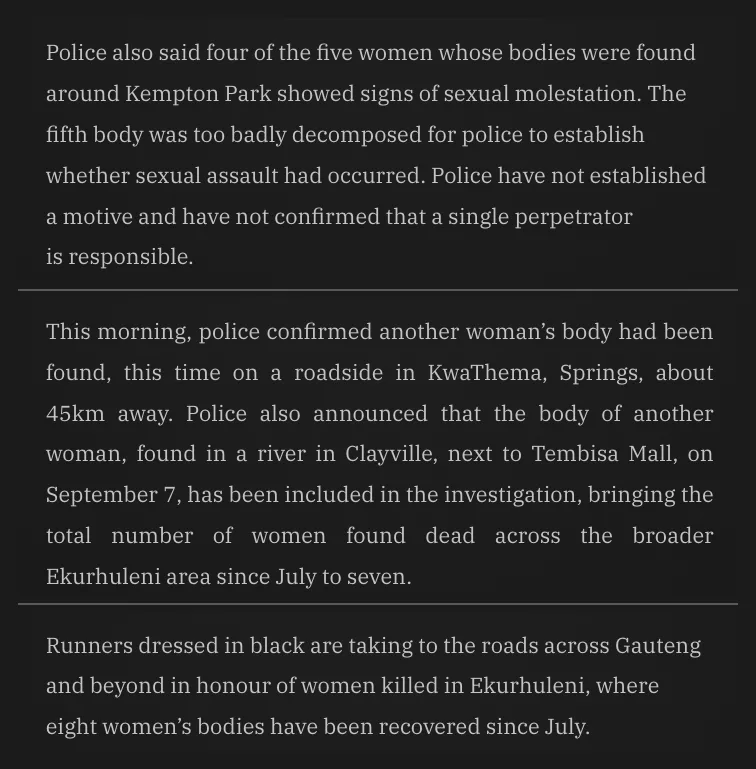
The acting national commissioner, Lieutenant-General Puleng Dimpane, said something that evening that explains a lot. Of the case picked up that day, she said: "So we might have missed this particular case when we did our numbers. It was picked up today." Read that again. The count was not a list of women. It was a tally, kept by hand, and it had a hole in it.
Part of the jump was geography too. "Four in Rhodesfield" became "eight across Ekurhuleni" because the police widened what they were counting. If you grew up in Kempton like I did, you know Olifantsfontein and KwaThema are not "around the corner". They are in the same metro and nowhere near each other.
Nine, with names
On Thursday 17 September a ninth body was found in Dawn Park, and for once the number came with a statement from Gauteng Community Safety the same day.
Three days later the Inter-Ministerial Committee (IMC) on gender-based violence did what nobody had done before. It published the nine as a list: names, a date and a place for each, in the order they were found. One name was held back because the family hadn't been told yet. That list is the backbone of my register. Rows one to nine carry the committee's own sentence as the reason they are in the count. It's the single most useful page anyone in government has published on this case.
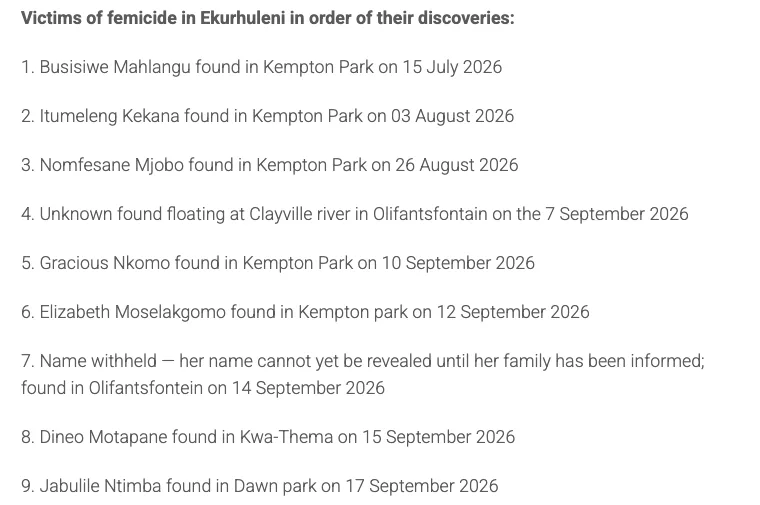
On 21 September Cachalia said eight of the nine had been identified. From here on there were two numbers in every report: bodies, and names.
Ten, eleven, and a twelfth that wasn't
A word on numbers before this section. From here on, when I say "the tenth" I mean the register's number, which follows the police count's order. The news numbered the bodies as they came, before the Soweto woman was counted in, so the news's tenth is my eleventh.
What the news called the tenth was found at Mooifontein Cemetery in Tembisa on Saturday 26 September: Ntombifuthi Nxumalo, number eleven in the register. What the news called the eleventh, number twelve here, was found in an open veld in Springs the next morning. News24 reported it within hours, and the Gauteng police spokesperson, Brigadier Brenda Muridili, said the task team had been sent to the scene.
On Monday 28 September a 23-year-old woman was shot on her way to work in Tembisa and her belongings were taken. Two outlets called her the twelfth. The police didn't. Muridili said no link had been established with the other cases, and Daily Maverick reported that her murder "is not being investigated as part of the task team looking into the earlier cases". A man described as her estranged husband was found dead in a vehicle in Midrand the same day.

She is in my register, because she was found dead in Ekurhuleni in the same weeks and two independent outlets reported it. She is not in the police count, and her row says so. She is the thirteenth. The whole difference between twelve and thirteen is her.
Twelve
So who is the twelfth in the police count? On 29 September the President said eleven. On 2 October Mthombeni said twelve, three still unidentified, three cases resolved.

My best answer: a woman found on 20 September near a dam in Moroka, Soweto, wrapped in a duvet, number ten in the register. Soweto is Johannesburg, not Ekurhuleni. A police spokesperson confirmed the discovery on 21 September. SABC News had been counting her since 26 September, as one of "eleven women who were found murdered in Ekurhuleni and Soweto", and IOL's count of twelve includes her.
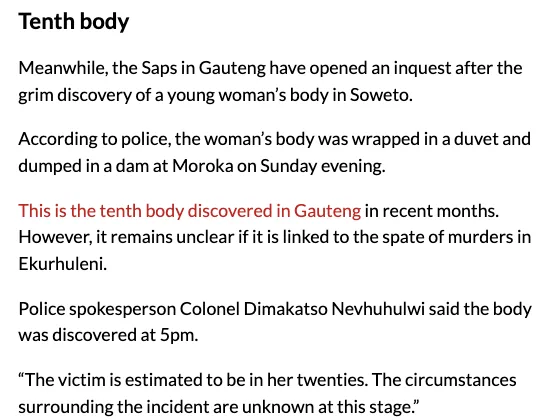
I say "best answer" because no official sentence in the record lists her. The commissioner gave a number, not a list. The register keeps her in the count on the outlets' word, and says on her row that that is what it's doing. If a police statement ever names the twelve, her row will carry it instead.
How I count
Thirteen rows. A row exists when an official source reports a body, or when two independent outlets with reporters on the ground do. One outlet's say-so gets listed apart and not counted. A row is in the police count when a sentence, usually from the IMC list, says so. Rows ten to twelve are in the police count on outlet sentences, not on an official list, and say so. Row eleven's discovery itself is confirmed by a SAPS statement; it's her place in the count that rests on the outlets. Row thirteen is marked as outside the count because the police said she is.
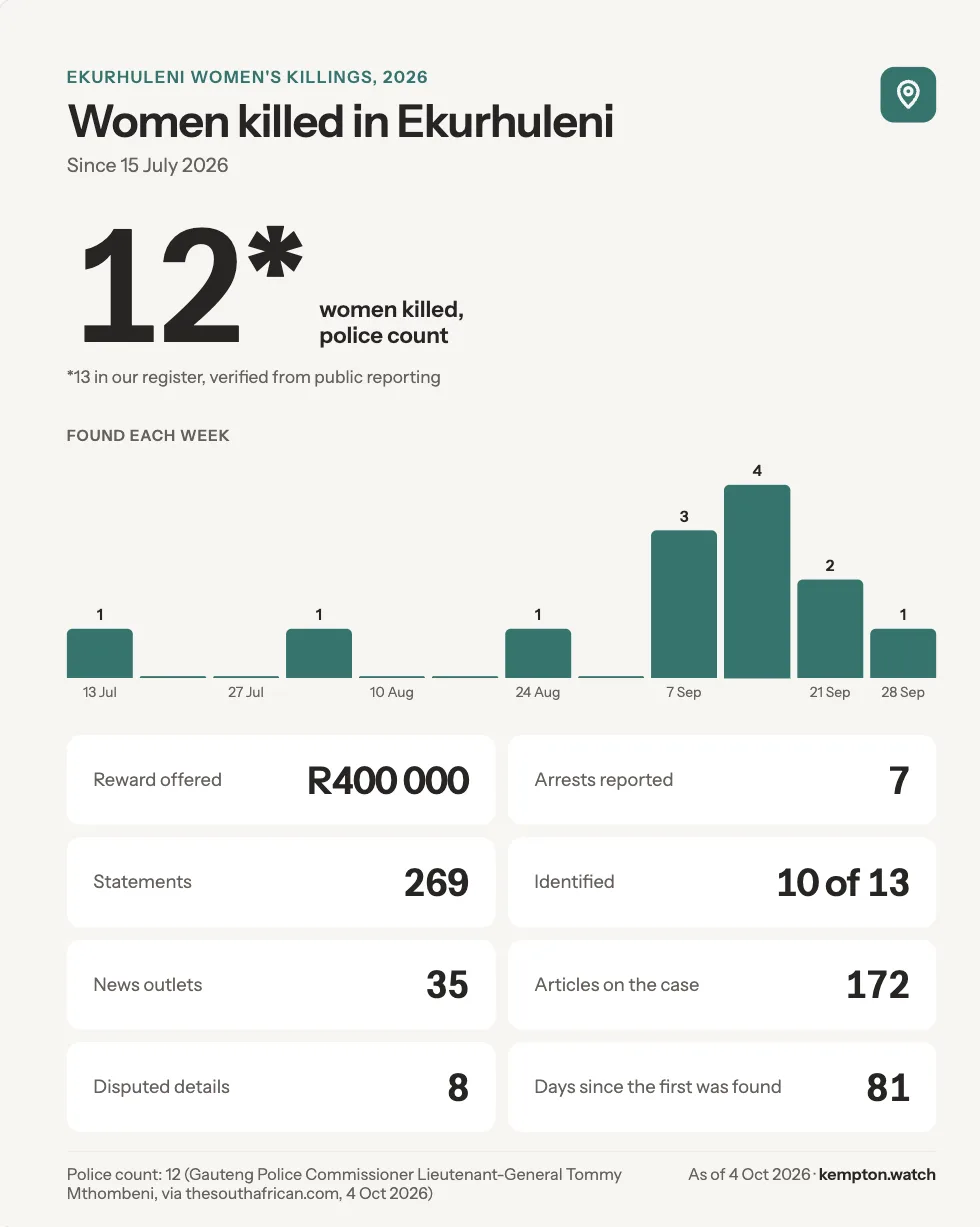
Every count on the site is dated. The register shows thirteen with the police number next to it. The sources page shows how every tally moved and who said it. If you have an AI assistant, you can put it on the case file and ask it yourself. You don't have to trust me. Check the links.
My count was wrong too
Ag, I'm not going to pretend otherwise. Until 4 October this register had seventeen rows. Four of them were women counted twice. A woman reported "near the R21 on 24 August" and a woman reported "in Pomona on 3 August" were both Itumeleng Kekana. The woman shot in Tembisa on 28 September was listed under two surnames, because two outlets spelled it two ways. Earlier, three reports of Saturday 12 September in Rhodesfield and Kempton Park turned out to be one woman, Elizabeth Moselakgomo. Outlets had reported one body under two dates, two places or two names, and the pipeline that reads them did what the outlets did. And one of the fixes made a new mistake on Gracious Nkomo's row, which part two tells in full. Every merge is logged with its reason, and you can read the log through the MCP.
That's the honest lesson of the count. The numbers in this case moved because bodies were found. They also moved because cases were missed, double-counted, reported under the wrong date, or counted in from the next municipality. The only cure I know of is a list, with a sentence and a link behind every line. That's what this site is for.
What the number doesn't tell you
Three of the twelve are still unidentified; one of them has been for four weeks. If you are missing someone, the police have asked families to come forward.
Three of the twelve have arrests. They look nothing like each other. That's part three.
And none of the numbers tells you whether these deaths are connected. Mthombeni on 26 September: "not something which we can overrule to say there's a serial killer, but we cannot conclusively indicate as such." Nothing since has changed that.