Send a Tip, Write It Up, Build On It: The Record for People Who Do More
Using the record, part 3 of 3: tips, posts and research.
By Piet Speurder · · 6 min read
MCP consentjournalistsresearchtips
Your assistant will be able to pass a tip to me, with your consent and in your words, once the tip form reopens. Journalists can draft posts from the record. Researchers can cite an exact version of it. Part three of three, and the rules that hold all of it together.
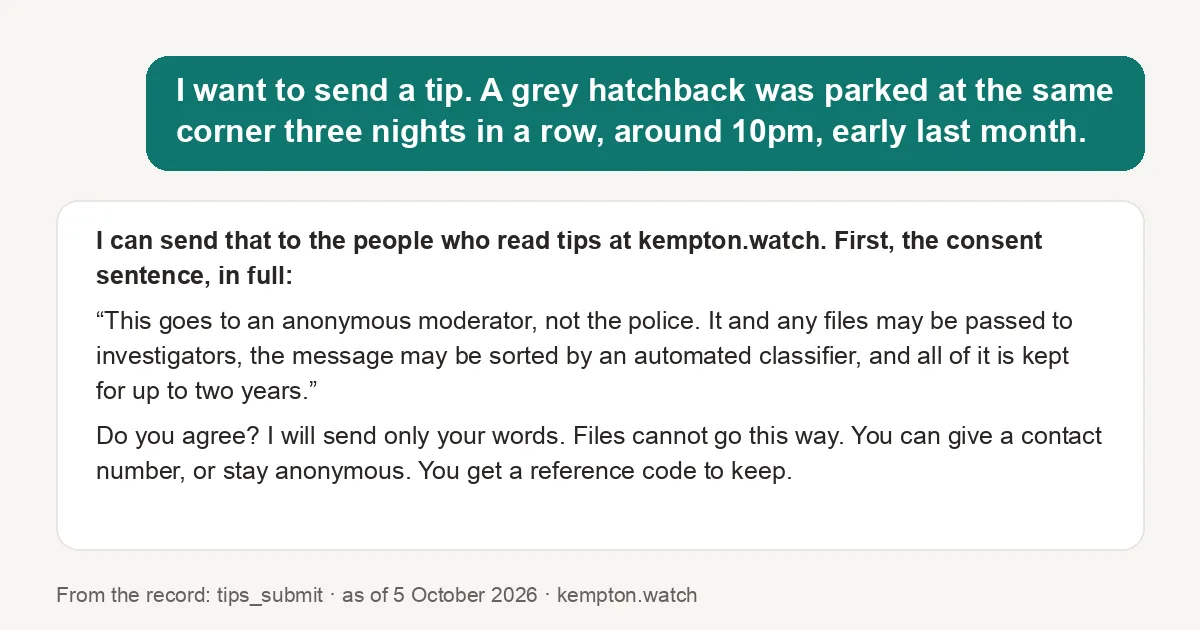
Kempton Watch, the tip flow through an assistant, 5 October 2026
Parts one and two were about reading. This one is about doing: passing on something you know, writing about the case from the record, and building on it. It's the most advanced of the three, and the first half still needs nothing more than a chat app.
Send a tip through your assistant (paused)
Say you saw something. A vehicle, a person, a time. You don't want to fill in a form and you're not sure you want to phone anyone. The record has a door for that: you tell your assistant, and it can pass what you said to me and the small number of vetted helpers who read tips, in your words, with your consent, and nothing else. The card at the top of this post is what that exchange looks like: what you tell the assistant, the consent sentence it reads back to you, and the reference code it returns.
When it opens, this is how it will work. The assistant reads you the consent sentence first, the same one the website shows, and sends nothing until you've agreed to it. It sends only what you told it to send. It cannot attach files; for a photo or a document, the website's form is the place. You can give a contact number or stay anonymous. And it gives you a reference code when it's done. Keep that code: quoting it, here or on the website, has the tip taken out of use at once and destroyed within thirty days. Nobody can test a code to see if it's real, so the code doesn't give you away either.
A few things that will still matter then:
- The tip comes to me, not to the police. Tips will be read by me and a small number of vetted helpers, all with two-factor login, and passed on through the partner. For anything concrete, Crime Stop on 08600 10111 is where it must go, and if someone is in danger right now, 10111. I say this every time because it's true every time.
- It's limited on purpose. Five tips a day from any one address, so nobody can flood it.
- What happens next is on the privacy page: the message is encrypted, an automated classifier may sort it for review, it may be passed to investigators, and it's kept for two years. That's the sentence you would be agreeing to, spelled out.
If you write about the case
Journalists and the people who help keep this record can sign in to a second door, and their assistant can draft posts from it. Accounts come through the get involved page.
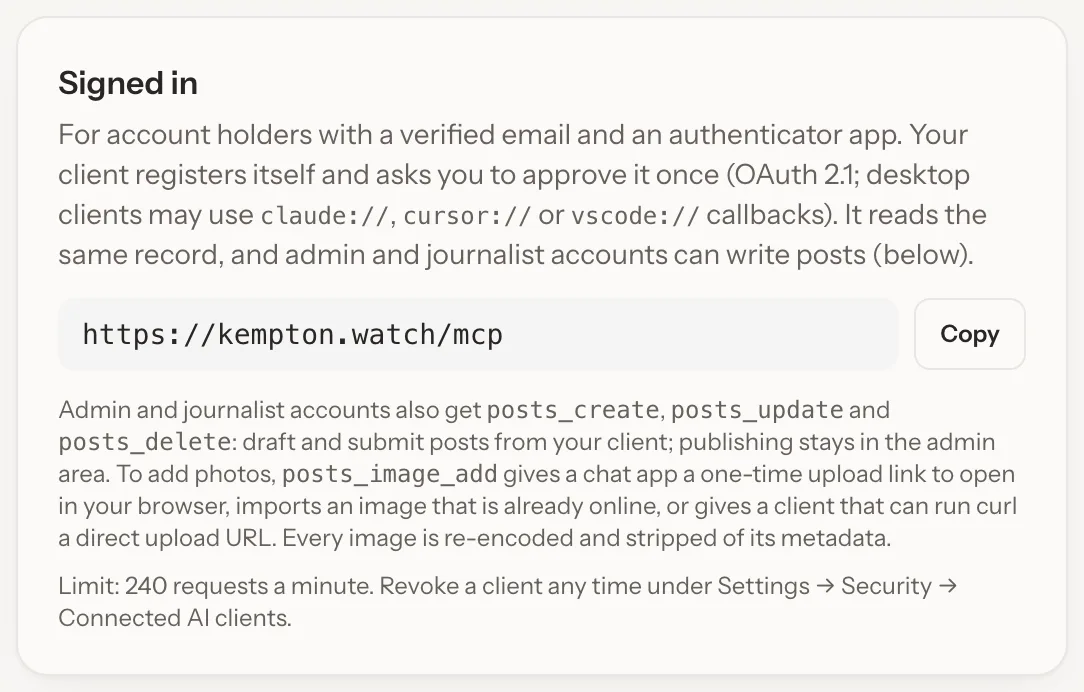
It works like this. Your account needs a verified email and an authenticator app. You give your assistant the signed-in address instead of the public one, and your browser opens once to approve it. From then on the assistant reads the same record, and if your account is a journalist's or an admin's, it can also draft a post, revise it, attach images, and submit it for review. Publishing stays a human step, in the admin area, with a checklist: names only as published, suspects never named, no last-seen addresses, linkage stated as unconfirmed. The assistant can't tick that box. Only a person can.
The case-record posts, on the count, the places and the arrests, were researched this way: an assistant on the record, every claim pulled with its source, then written and checked by hand. It's a good way to work. It doesn't replace reading the source. It makes sure you have the source to read.
You can take a client's access away at any time under Settings, then Security, then Connected AI clients.
If you build on it
For researchers, students and the technically curious, three things make the record citable rather than just readable.
Every answer carries two stamps. An "as of" time, which is when the record was last refreshed, and a version code that changes whenever the data changes. If you quote a figure, quote the version with it. Anyone can then ask for exactly the record you saw.
There's a scripting door that needs no chat app. One line in a terminal fetches the case overview as data. The connect page shows it, with recordings. It's how the charts in the earlier posts were made.
The limits are generous and written down. Sixty requests a minute and three thousand a day from one address, search thirty a minute. Signed-in accounts get more.
What you can't do is write to the record. The register, the statements and the counts come only from the pipeline that reads the outlets, with a human override that has to carry a reason and a date. If you think a line is wrong, write to hello@kempton.watch, as the sources page says, and the correction, if there is one, is logged.
The rules, once more, in full
Everything in this series rests on the same five rules, and the connection passes them to whatever reads it.
An assistant that breaks one of them didn't get it from here.
Where to get help now
The record also lists where to turn, and your assistant can read that too. Ask "where can I get help?" and you'll get POWA's Tembisa office and its counselling and legal lines, the GBV Command Centre on 0800 428 428, Childline on 116, LifeLine on 0861 322 322, the Thuthuzela Care Centres at Tembisa and Thelle Mogoerane hospitals, and Legal Aid on 0800 110 110. The site publishes no bank details for anyone, so anything asking for money in its name isn't it.
That's the series. Connect it, ask it, check things, follow the case, and if you know something, pass it on.