How to Share a Tip Safely
Where to take what you know today, what to include, what to leave out, and what our own form will do when it opens.
By Piet Speurder · · 5 min read
About anonymityprivacyrewardstips
If you saw, heard or know something about the women found dead in Ekurhuleni, here is how to pass it on without putting yourself at risk: where to take it today, what to include, what to leave out, and what our own tip form will do when it opens.
Kempton Watch
For support after violence or abuse, the GBV Command Centre is open 24 hours on 0800 428 428.
Where to take it today
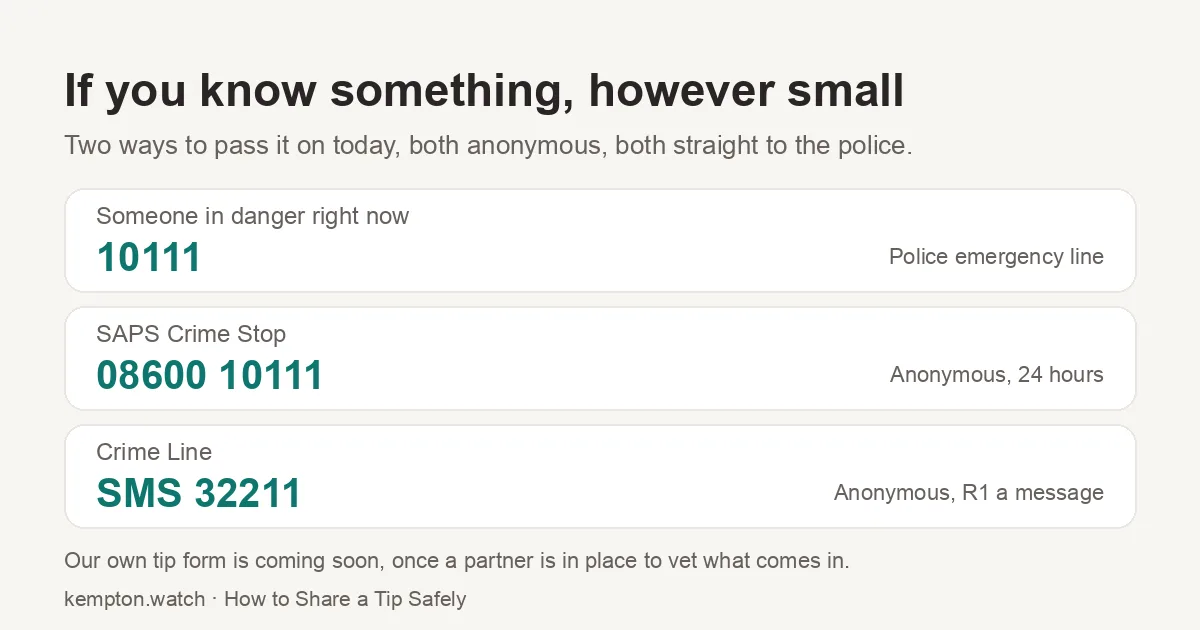
Two routes, both anonymous, both straight to the police.
| How | Anonymous? | Who reads it | |
|---|---|---|---|
| SAPS Crime Stop | Call 08600 10111, 24 hours | Yes | The police, directly |
| Crime Line | SMS 32211 (R1 a message) | Yes | The police, via Crime Line |
Our own tip form is coming soon. I have paused it until two things are in place: an official partner organisation to help manage and vet what comes in, and a thorough safety review of the form itself. When someone trusts a site with critical information, and especially with photos, videos or voice notes, that site has to be able to guarantee it is handled safely and reaches an official channel. I would rather open late than open wrong. The tip page says the same, and the weekly email will say the day it opens.
Before you call or write: small things matter
You don't need to be sure. "I saw a car parked at the same spot three nights in a row" is worth passing on. So is something that seemed odd at the time.
Helpful details:
- When: the date and time, even roughly ("a Tuesday evening in early September").
- Where: a street, landmark or area.
- What you saw or heard yourself, kept apart from what other people told you. Both are useful, but investigators need to know which is which.
- Descriptions: a vehicle's colour, make or partial number plate, clothing, or a voice.
Say what you saw, not what you think. "A grey hatchback parked at the same corner three nights in a row, around 10pm, early last month" is useful. "I think it was so-and-so" is a name. If you think you know who it is, say so to Crime Stop, where it can be checked, rather than anywhere public.
Staying anonymous
You don't have to give your name. Crime Stop and Crime Line take tips without one. If you want to be reachable, say so and give one number; otherwise leave yourself out of it.
Watch what you say about yourself. "I saw it from my bedroom window at number 12" can identify you as clearly as a name. Describe what you saw, not where you live.
Photos and videos carry hidden information. Most phones record where and when a photo was taken inside the file. That can help an investigation, but if you took the photo at home it also shows where you live. Before you hand a photo to anyone:
- iPhone: in Photos, tap Share, then Options at the top, and turn off Location before saving or sending.
- Android: in Google Photos, open the photo, swipe up, and choose to remove the location (the wording differs by phone).
- Or take a screenshot of the photo and send the screenshot. It won't carry the original location.
On a shared phone or computer, use a private or incognito window, and close it when you're done.
When our form opens
So you know what you would be agreeing to. When the form opens, this is what will happen to a tip, and the privacy notice is the full version.
- You get a reference code. It is the only way to ask for your tip to be deleted later, so keep it somewhere private.
- It is read by me, with a small number of vetted helpers and the partner organisation. All our accounts need two-factor login.
- It may be sorted automatically. To help sort many messages, the text may go through an automated checker. It never sees contact details or files, and it doesn't learn from your tip.
- It is passed to the police where relevant, through the partner, with any files.
- It is kept for two years, encrypted, and then destroyed. Your IP address is never stored; a scrambled, one-way version is kept for two days to block abuse, then deleted.
Sent a tip before the pause and changed your mind? The tip deletion page still works. Enter your reference code and the tip is hidden straight away and destroyed within 30 days. Nobody can test a code to see if it's real, so the code doesn't give you away either.
Please don't
- Don't investigate or confront anyone yourself. Pass on what you know and let the police act.
- Don't name or post about people on social media. A wrong accusation can ruin, or cost, an innocent life. In September a man was killed by a crowd over the Kempton Park murders.1 Officials have said repeatedly that the deaths are not confirmed as linked. A rumour about "the killer" can point people at the wrong person.
- Don't tell others you passed on a tip if it could put you at risk.
About the rewards
There are two, and they are not the same. The police have offered R400 000 for information that helps the investigation. The DA's Ekurhuleni mayoral candidate has offered R500 000 separately, and the police have said they cannot be involved in political matters, so the two are not combined. I can't pay or promise rewards. If you want to be considered, contact the police directly on 08600 10111 and ask how it works.
Thank you
Every tip matters. If you're holding on to something because you're unsure it matters, take it to Crime Stop anyway.
TimesLIVE, 25 September 2026: Mob justice under spotlight after man is killed over Kempton Park murders. ↩