Introducing Kempton Watch
What the site is, what it is not, how it is built, and what you can do with it.
By Piet Speurder · · updated · 5 min read
A volunteer-built public record of the Ekurhuleni women's killings, and an experiment in whether today's AI tools can help a community stay informed. Every fact links to its source. Not the police.
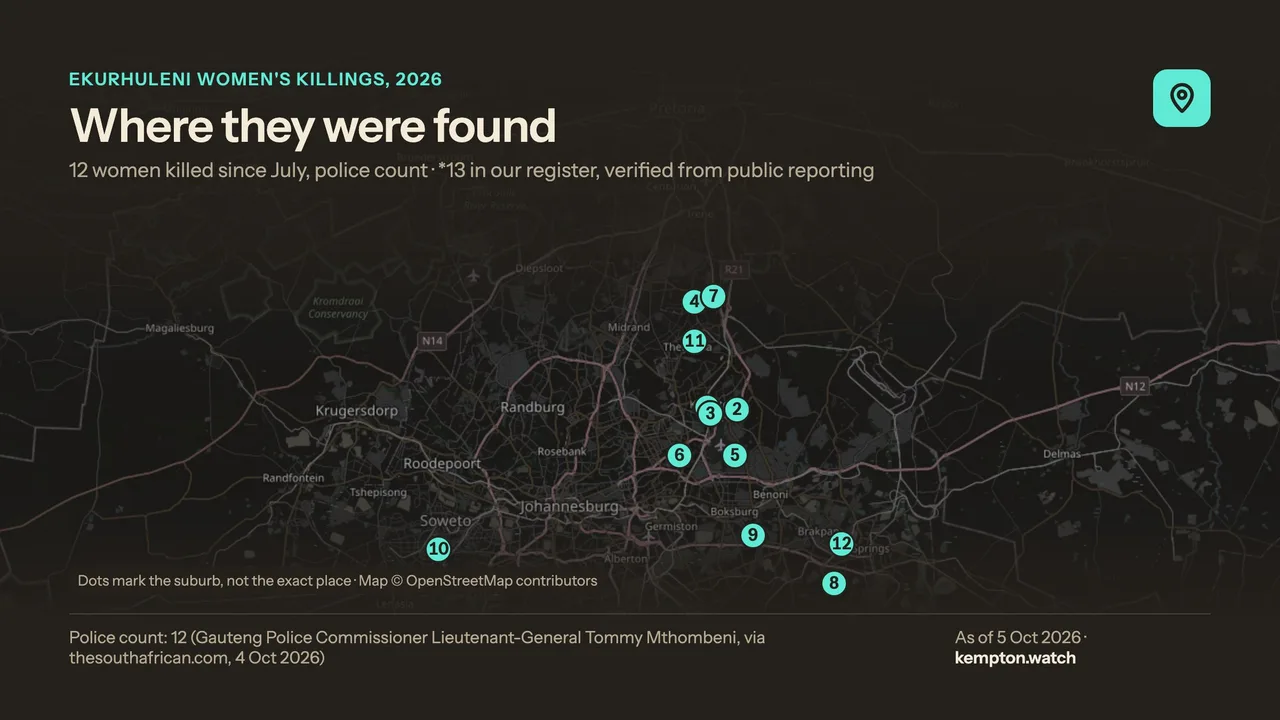
Kempton Watch, from the record as of 5 October 2026
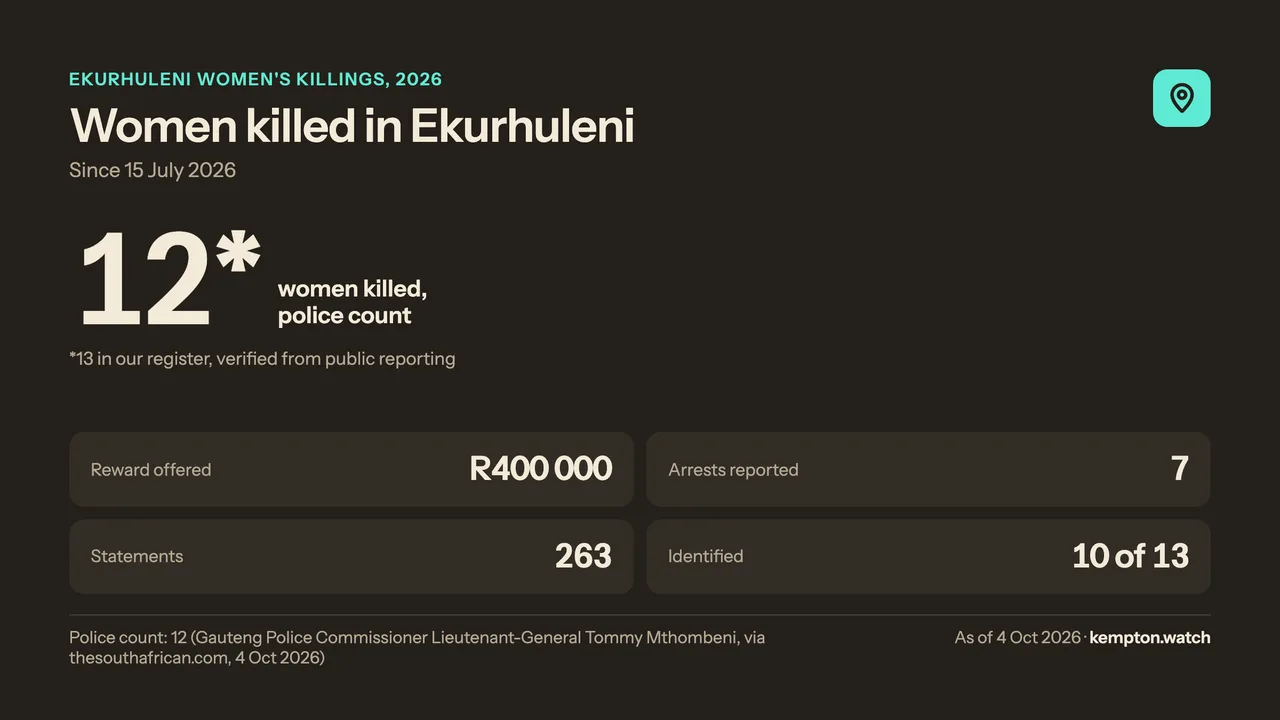
Thirteen women had been found dead across Ekurhuleni between July and 4 October. The reporting on them was scattered across thirty-five outlets by 4 October, and it doesn't always agree. Kempton Watch puts it in one place, and shows the source behind every line. It is also an experiment: can today's AI tools help a community keep its own record, one anyone can check?
The name comes from Kempton Park, where the first four women were found and where I grew up. The record covers the whole metro, and one case outside it.
This post explains what the site is, what it is not, how it is built, and what you can do with it.
What it is
Kempton Watch gathers what news outlets and official statements have published about the women found dead in Ekurhuleni since July 2026, and keeps it in one place.
- A register of the victims, in the order they were found, with a map at suburb level.
- What officials and experts have said, quoted where they were quoted and marked where an outlet paraphrased, newest first, with arrests and court dates as reported. See statements.
- A source behind every fact. Each line shows the sentence it rests on and a link to the article.
- Disagreements shown, not settled. When outlets differ on a date, a place or a name, the conflicts page lists every version and who said it.
- A tip form, coming soon. It is paused until an official partner is in place to help vet what comes in, and until the form has had a full safety review. Until then, anything you know goes to Crime Stop on 08600 10111. The tip page explains.
- A weekly email with what changed, for anyone who wants to follow the case without reading a dozen sites.
Everything comes from the public domain: more than thirty outlets and the government's own media statements. The full list is on the sources page.
What it is not
- Not the police. The site has no connection to SAPS or to any government body.
- Not a theory. It names no suspects and does not guess at who did this.
- Not a verdict on whether the deaths are linked. Officials have said that is not confirmed. The record says the same.
- Not a tabloid. Victims are named only as an official statement or an on-the-ground outlet named them. Locations are where a woman was found, never where she lived.
How it is built
This is where the technology comes in.
A pipeline reads the articles and statements, pulls out each claim together with the sentence that supports it, and checks that the sentence really appears in the article. A claim without a matching quote is dropped. Sources are ranked: official statements first, reporters on the ground and wire copy second, rewrites and aggregators third. A fact is marked confirmed only when an official source states it or two independent on-the-ground sources agree.
The AI does the reading and the matching. It does not decide what is true. Where outlets disagree, the disagreement is published as data, and a person reviews anything that touches a name.
For the technically minded
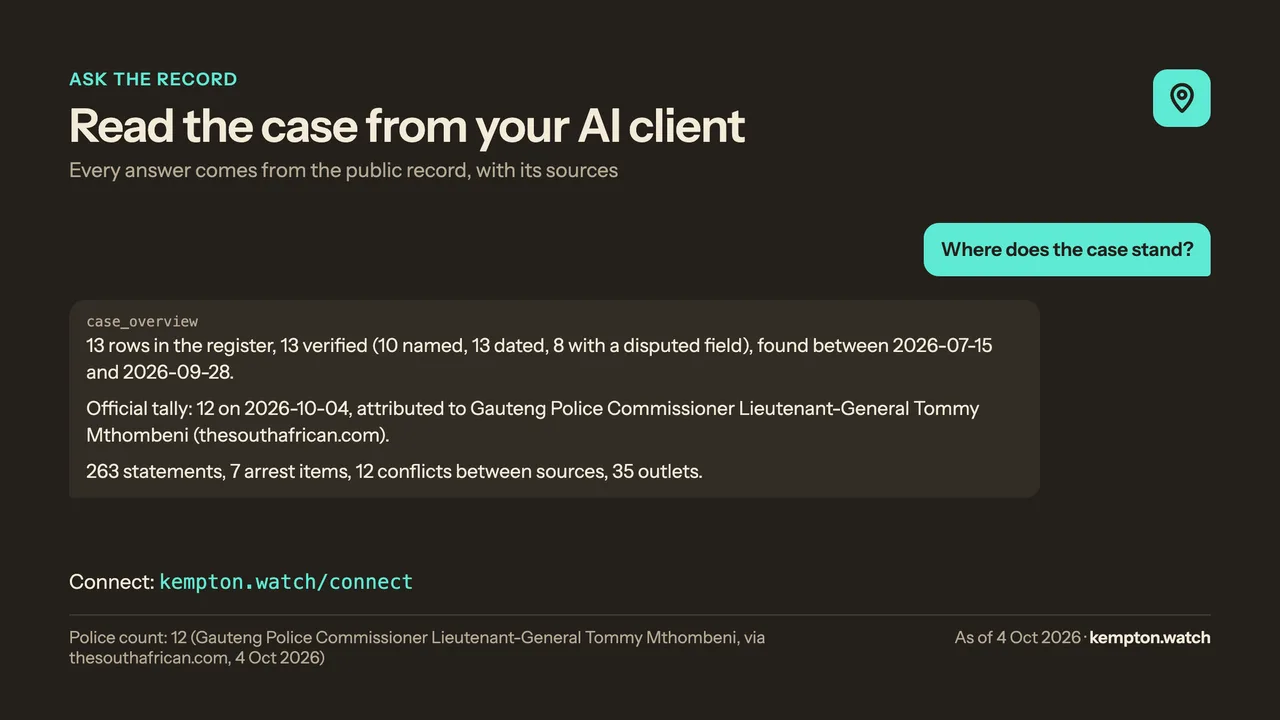
The whole record is also an MCP server. MCP, the Model Context Protocol, is the open standard that lets an AI assistant such as Claude or ChatGPT read a data source directly. Point your assistant at the server and ask it to brief you on the case or to check a claim you saw online. Every answer carries the quote and link behind it, and the same rules apply: names only as published, suspects never named, disagreements never resolved silently. Setup for each client is on the connect page.
I think this matters beyond one case. A community can keep its own record, checkable by anyone, without waiting for someone else to do it. And the same tools that flood the internet with guesses can be made to do the opposite: read everything, invent nothing, and show their sources.
What you can do
- Read the record and check it. If something is wrong, the sources page says where to write. Corrections are made when a source corrects, when an official statement contradicts, or when I find a pipeline error, with the reason logged.
- If you know something, however small, call Crime Stop on 08600 10111. It is anonymous and open 24 hours. If someone is in danger now, call 10111.
- Follow the case to get a short summary every Monday, and to hear when the tip form opens.
- Pass the site on to people in Ekurhuleni.
Read next
- From the record, in three parts: the count, the places, and the arrests.
- Ask the record yourself: connect an AI assistant in five minutes, then check a claim and follow the case.
- If you know something: How to Share a Tip Safely.
Who runs this
Piet Speurder is a pen name. I grew up in Kempton Park and live abroad now, and I run the site anonymously because of what it covers. I am not a police officer, a detective or a journalist, and I have no link to any victim's family or to any government body. I am working on a safe channel to the police task team and on an official partner to help vet tips. Until both exist, the tip form stays paused, and Crime Stop comes first in every post.
You don't have to trust me. Every line links to its source.
Contact
Corrections and questions about the record go to hello@kempton.watch, as the sources page says. To reach me directly: pietspeurder@proton.me. Tips go to Crime Stop, never by email.